
Learning Objectives
After completing this unit, you'll be able to:
- Describe the core financial services objects and how they relate.
- Explain how households and relationships are modeled.
- Identify where Data 360 extends the data model.
Accounts, Households, and Relationships
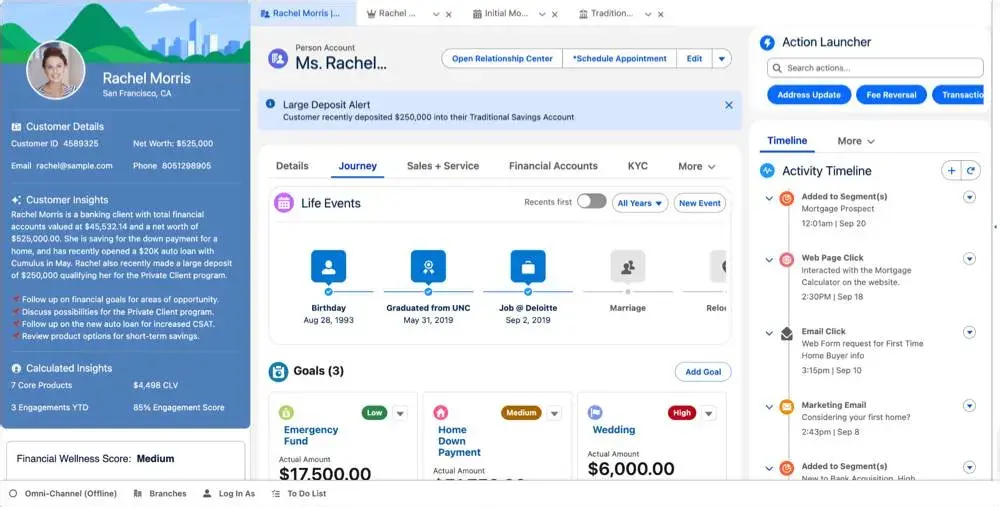
Banks and advisors think about customers differently than a typical CRM does. A single client might hold a checking account, a mortgage, and a retirement plan, and share some of them with a spouse. The Agentforce Financial Services data model captures that structure so every team sees the same picture.
Person accounts represent individual clients. Households group the people who share finances. Financial accounts hold the products a client owns, with roles that show who is the primary owner and who is a joint owner.
Tip
Model relationships once and reuse them everywhere. Service reps, advisors, and agents all read the same household record, so a change made by one team shows up for the rest.
Financial Objects at a Glance
A few objects do most of the work. Learn these and the rest of the model makes sense.
Term
Financial Account
- Financial Account Roles record who owns or has authority on an account.
- Financial Goals connect plans to the accounts that fund them.
- Assets and Liabilities capture what a client holds elsewhere so advice reflects the whole picture.
Quick Check
A married couple shares a mortgage and each has a personal checking account. How does the data model represent the shared mortgage?
Extend the Model with Data 360
Most account data lives in core banking and other systems of record. Data 360 brings it in without copying every transaction into Salesforce, then maps it to the financial services model so profiles stay current.
Resources
Quiz
To complete this unit, you need to answer all the quiz questions correctly.
+100 Points
1Which object groups the people who share finances?
2Why use Data 360 with the financial services data model?